
Essay · May 2026
Not to Participate in the Lie
A note for whoever still believes the country is worth the trouble.
We started with a small thing — a court ruling about a map. We ended somewhere larger, the way these conversations do when you let them.
The map was just a map. A line drawn around a community, then redrawn around a power calculation, then redrawn again around a power calculation pretending to be a fairness calculation. The map matters, but it is not the disease. It is the symptom of a country that no longer trusts itself enough to share a common picture of itself.
That is the real subject. Not the map. The trust.
We have all noticed — most of us privately, some of us out loud — that the institutions which were built to serve us no longer answer to us. The press tells us what to feel before it tells us what happened. The courts decide first and reason backward. The schools teach our children theories we were never asked to vote on. The agencies regulate lives they do not live.
This is not paranoia. It is observation. And the names on the file go back further than the news cycle.
Frederick Winslow Taylor built the lever in the 1890s, when he taught American industry that knowledge of the work should be taken out of the worker's hands and placed in the hands of a credentialed manager who plans, measures, and controls. Herbert Croly picked it up in 1909 and wrote The Promise of American Life, arguing for "Hamiltonian means to Jeffersonian ends" — centralized expert administration delivering populist outcomes. Woodrow Wilson wrote his doctoral thesis arguing that politics should be replaced by scientific administration, then spent his presidency building the Federal Reserve, the income tax, and the modern administrative agencies to do exactly that. Margaret Sanger entered through the same door, openly tying contraception to eugenic population control and writing in 1939, in her own hand, that "we do not want word to go out that we want to exterminate the Negro population." The tools she built outlived the language she used to justify them.
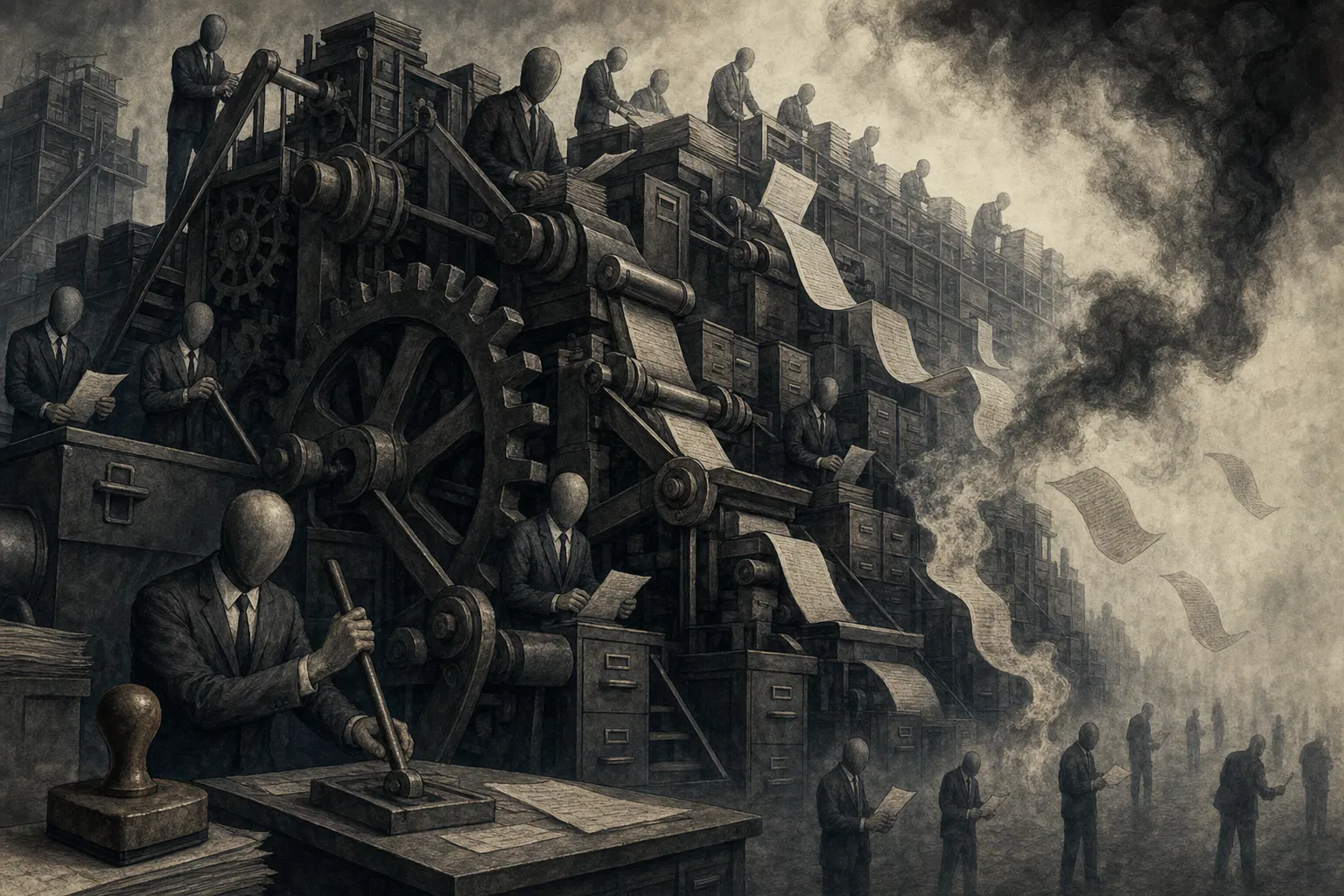
The machine produces documents. The documents dissolve. No author. No accountable hand. Plausible deniability by design.
By 1941, James Burnham — once a Trotskyist, later a founding editor of National Review — looked at what had been assembled and named it. The Managerial Revolution: ownership had been replaced by control, and a new class of administrators would dominate the 20th century in every country regardless of ideology. He was right. Christopher Lasch said the same thing from the left in The Revolt of the Elites (1995): "The new elites are in revolt against 'Middle America,' as they imagine it: technologically backward, politically reactionary, repressive in its sexual morality, middlebrow in its tastes, smug and complacent, dull and dowdy." He saw a managerial class that had seceded from the country it governed — sending its children to different schools, fighting in different wars (or not at all), sharing none of the fates of the people whose lives it administered.
Sam Francis extended the diagnosis in Leviathan and Its Enemies: the managerial system pursues its class interests under the language of expertise, public good, and progress, and it operates as what he called anarcho‑tyranny — anarchic toward the disorder it can use politically, tyrannical toward ordinary citizens it wants to control. Patrick Deneen finished the arc in Why Liberalism Failed (2018), arguing the system was not corrupted from outside but was working as designed.
What ties all of these names together is the mechanism. The managerial regime is a weapon with a silencer. It never makes an audible report. The shot goes off, the harm lands, and when you turn to find the source — there is only a process, a committee, a "stakeholder consultation," a foundation grant, a peer‑reviewed study, a court ruling, a regulation cross‑referencing another regulation. No author. No accountable hand. Plausible deniability by design. That is not a bug. It is the whole point.
The line runs unbroken: from Taylor's stopwatch to Sanger's clinic to Wilson's bureaucracy to today's antinatalist philosophers — David Benatar writing in Better Never to Have Been (2006) that bringing humans into existence is a moral harm — to the climate activists who tell young women not to have children, to the school administrators who teach kids their own civilization is a crime, to the city officials who let neighborhoods burn and the donors who funded the bail to put the arsonists back on the street the same night. Different costumes. Same silencer.
The country is not dead. The country is the people in it.
But here is what we should not do. We should not despair. We should not declare humanity rotten. We should not give in to the temptation — and it is a temptation — to believe that good people are gone, that the country we loved is dead and only its embalmed corpse remains.
That is the deepest lie of all. And it is a lie we tell ourselves, not one they tell us. They benefit from it, but we are the ones who pick it up.
The country is not dead. The country is the people in it. And the people in it — the actual people, not the polls about them — are mostly decent, mostly tired, mostly trying to raise their kids and pay their mortgages and not be lectured by people who have done neither. The country lives in those people. As long as they are alive, the country is alive.
What is dying is something else: a particular regime of managerial control that sold itself as inevitable, scientific, and moral, and which is now being exposed by reality faster than its operators can paper over the gaps. The fertility numbers are exposing it. The cities are exposing it. The schools are exposing it. The lies — the small daily lies and the catastrophic public ones — are exposing it. Reality, as it always does eventually, is winning.
Our job is not to defeat the regime. Reality is doing that work. Our job is to not participate in the lie while it does.
What It Means in Practice
What does that mean in practice? It means small things and it means everything.
It means telling the truth in your own life, in the room you are in, to the people in front of you. Not the big philosophical truth that nobody asked for. The small specific truth — that the policy is failing, that the emperor has no clothes, that the meeting is performative, that the curriculum is wrong, that the news is shaped, that the neighbors you are told to fear are not the ones to fear. Tell it kindly. Tell it once. Then tell it again.
It means building things instead of consuming them. A business. A garden. A family. A skill. A habit. A friendship. A church. A neighborhood. A meetup. A tradition. The managerial regime atomizes because atomized people are easier to govern. To build a real connection — to two people, to ten, to a hundred — is itself a quiet act of resistance.

Build something. A business. A garden. A family. The world will be saved, if it is saved, in concentric circles — not in press releases.
It means having children if you are able, raising them well, and teaching them to think for themselves rather than to perform the approved emotions. Civilizations that do not reproduce themselves do not survive, and no political fix can substitute for the simple act of bringing the next generation into being and giving them something worth inheriting. Eric Kaufmann has shown with hard demographic data that the future belongs to those who show up for it. So show up.
It means refusing the small lies — the words you don't believe, the acknowledgments that acknowledge nothing, the statements that signify nothing, the safety theater, the language games. Not loudly. Not as performance. Just quietly, consistently, refusing to mouth the words. Aleksandr Solzhenitsyn, in his last essay before exile from the Soviet Union in 1974, "Live Not by Lies," gave the whole prescription in one sentence: "Let us refuse to say what we do not think." It costs almost nothing and changes almost everything.
It means caring for your own first — your family, your neighborhood, your city, your state — without apology, while still extending real kindness to strangers. The managerial class taught us to care about distant abstractions and to ignore the people on our block. Reverse it. Love what is actually near you.
It means rule of law, which we agreed on across hundreds of cultures and thousands of years before some clever people decided we were too sophisticated for it. Hammurabi wrote it on stone. Moses carried it down from Sinai. Cicero argued it before the Roman Senate. Aquinas grounded it in nature. Magna Carta put it on parchment. It is not a partisan idea. It is the precondition for any free people anywhere. Defend it where you are — on juries, on school boards, in city council meetings, in the courts when they call you. Show up.
It means forgiving the snakes in yourself first. None of us are clean. The temptation to power, to comfort, to performance, to status, to the small lie that smooths the awkward moment — those are in all of us. We are not the righteous remnant standing against a fallen world. We are flawed people trying to live truthfully in a hard time. That posture is humbler and far more durable than the posture of the crusader.
We will not be saved by a politician. We will not be saved by a party. We will not be saved by an election or a court ruling or a hashtag or a movement. We will be saved — if the word means anything in this context — by the slow accumulation of millions of small refusals, small truths, small acts of building, in millions of homes, on millions of streets, by people whose names will never appear in a book.
The map will keep getting redrawn. The headlines will keep getting written. The regime will keep insisting it is the only adult in the room. None of that is yours to fix.
What is yours to fix is the small piece of the world your hands can actually reach. Your job. Your kids. Your block. Your word, kept. Your debts, paid. Your neighbors, known. Your craft, mastered. Your faith, practiced. Your courage, exercised in the small daily ways that nobody will ever see.
Do that, and the lie loses one more participant. Do that, and you become something the regime cannot control: an adult human being, anchored in reality, doing what is true.
If enough of us do it, the country comes back. Not because we mounted a revolution. Because we simply refused to keep killing it with our complicity.
The map matters less than the man standing on the land.
Stand.
"This, then, we may call the perfect and final good of man… for it is for the sake of this that all men do all that they do. Now we call that which is in itself worthy of pursuit more final than that which is worthy of pursuit for the sake of something else… and therefore we call final without qualification that which is always desirable in itself and never for the sake of something else."
The whole project — the families, the work, the truth‑telling, the refusals — is not an end in itself. It is ordered toward the summum bonum: the good that needs no justification beyond itself, because everything else is justified by reference to it. Aristotle called it eudaimonia — flourishing. Aquinas called it the beatific vision. Cicero called it honestum — the honorable. Every serious tradition has named it. Every serious life has been ordered toward it.
We are not asked to win. We are asked to live truly, in the direction of the highest good, with whatever days we are given.
That is enough. That has always been enough.